THE PARISH CHURCH OF STOKE DAMEREL
(ST. ANDREW & ST. LUKE)
Email: info@stokedamerel.church
www.Stokedamerel.church
www.facebook.com/StokeDamerelChurch
Please note: Stoke Damerel Church does not divulge
personal information to third parties.
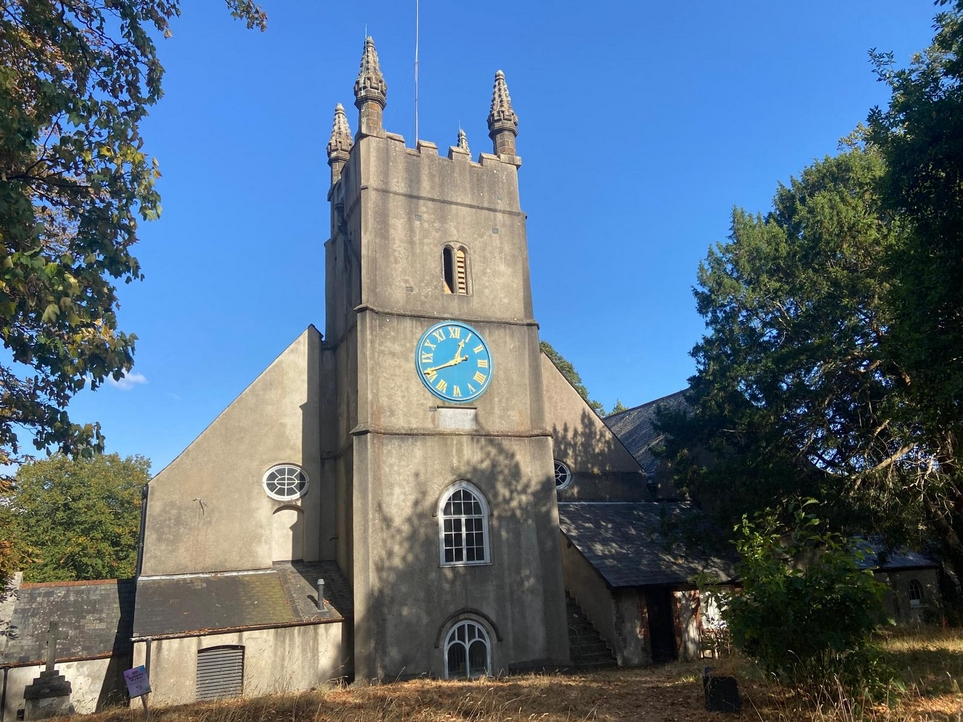
Sunday 18 October Luke the Evangelist
THIS WEEK'S READINGS
Sunday 18 October Luke the Evangelist
Luke 24:13-19. 25-35
NEXT WEEK’S READINGS
Sunday 25 October Bible Sunday
Nehemiah 8:1-4a (5-6) 8-12
Colossians 3:12-17
Matthew 24:30-35
Psalm 119
Merciful God,
we entrust to your tender care
those who are ill or in pain,
knowing that whenever danger threatens
your everlasting arms
are there to hold them safe.
Comfort and heal them,
and restore them to health and strength;
through Jesus Christ our Lord.
Amen.
PLEASE PRAY FOR:-
The sick:-
Margaret W, Graham, John S, Kathy, Mo, Matt,
Bertie, Morwenna, David J.
The long term sick and infirm:-
Diana, Liz & Keith N, Rob.
The recently departed:-
We give thanks for the life of Maureen Wilson and
we pray for her son, Bevan, and all her family and
friends at this sad time.
The Ministry Team:-
Rev'd Fran, Ruth and Marilyn.
BLESSED SACRAMENT CANDLE
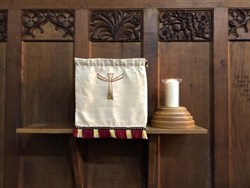
If you would like to have the candle lit for a week
for a particular prayer / thanksgiving /
commemoration, etc., please send a £5 donation to
Debbie Smith, clearly marking your donation as
being for the candle. Details of your intention can
be emailed to:- sarah.lundstrom@virginmedia.com
so that a mention of the commemoration, etc., can
appear in the Sunday Sheet.
SERVICES THIS WEEK
Stoke Damerel Parish Church is a hybrid church
open for public worship and private prayer and all
services will be live streamed.
By attending a live streamed service, you give
implied permission to have your image captured
on CCTV and to be broadcast as participant in the
liturgy.
Watch our livestreamed services
Please follow the link to make your way to our YouTube page:
STOKE DAMEREL YOUTUBE CHANNEL
Sunday 18 October Luke the Evangelist
0800 Holy Eucharist
1000 Sung Parish Eucharist
Presiding: Rev’d Dr Sacha Pearce
Wednesday 21 October
1000 Said Eucharist
Sunday 25 October Bible Sunday
0800 Holy Eucharist
1000 Sung Parish Eucharist
MARILYN'S MEMOS
ST LUKE’S SERVICE
We look forward to our special service on Sunday,
with guests organised by Tony and Rosie. Rev’d
Sacha Pearce, Derriford Hospital Chaplaincy, will
be leading our worship, in conjunction with Rev’d
Frances. Rev’d Sacha has been a regular priest
during our vacancy and, I am sure, will be warmly
welcomed.
LAST WEEK’S HARVEST CELEBRATION
Very many thanks for the wonderful array of goods
brought last week. Rev’d Sue was able to take a
considerable number of containers to the food
club, held at St Aubyn’s each Wednesday morning.
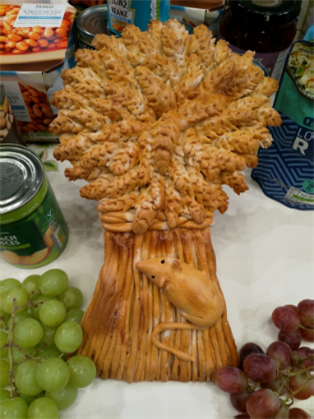 The amazing bread made by Ann for last week’s
Harvest Thanksgiving!
TWO CONCERTS
We welcome Plymouth Concert Series with their
first concert of the season on Sunday 25th October
and Divertimento String Quartet on Saturday 31st
October: both to be performed in the afternoon and
both well worth attending! Details can be found on
the posters.
CHRISTMAS FAIRS
13/14 November 11am to 3pm
Please continue to bring items on Sunday: good
quality bric-a-brac, books and seasonal goods for
our hampers. Keep up the marmalade and chutney
making!
Many thanks.
Marilyn
HARVEST GIFTS
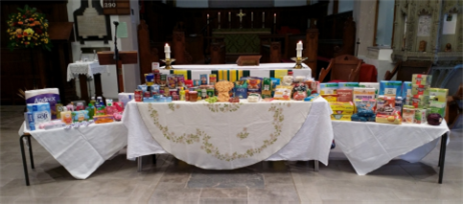
Thank you all so very much for the wonderful
number of items you donated to Devonport Food
Club from the Harvest last Sunday. My little car
was filled to the brim and a lot nearer the road
surface as I drove back to Devonport!
Rev Fran reminded us, in her sermon, that we have
no need to worry, God will take care of our needs
and our lives. But try believing that when you are
facing a winter with energy prices rising and a
family to feed. We know the Food Club can make
a real difference to some households by being able
to stock up with some essentials really cheaply;
you are showing others how God does find ways
of supporting us when we can't see the way
forward ourselves. And thank you very much to
the gentleman who gave a very generous financial
harvest gift.
If anyone would like to pop in on any Wednesday
morning between 8.45 - 10.30am, please do.
The kettle will be on!
Rev’d Sue
BLANKETS FOR UKRAINE
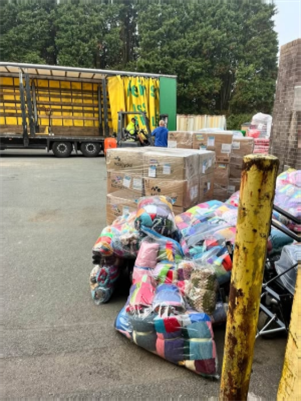
The artic set off on Monday 5th October for
Ukraine. Trip No 45! Look! We have loaded five
hundred blanket packs to go to Ukraine. Six of
them from US this month. Thanks ladies!
Ruth Jordan
HELLO FROM THE FALKLAND ISLANDS
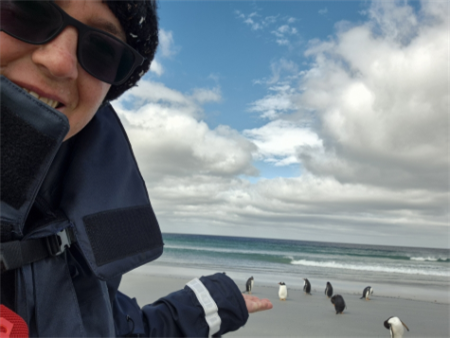
Greetings from the other end of the world!
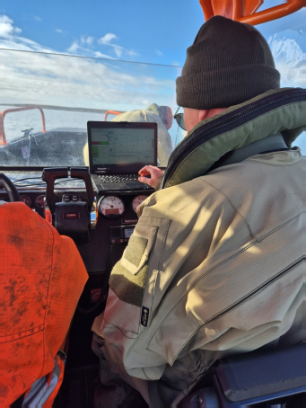
When I first joined the Royal Navy, I dreamed of
exploring distant horizons. Yet, when two major
ships from my branch were decommissioned, I
quietly wondered if those doors had closed forever.
Fast forward a few years, and I find myself 8,000
miles away in the breathtaking Falkland Islands.
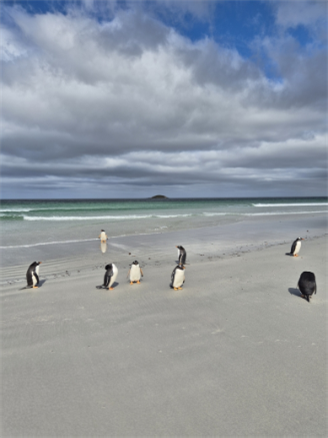
Sitting here, I am struck by a profound sense of
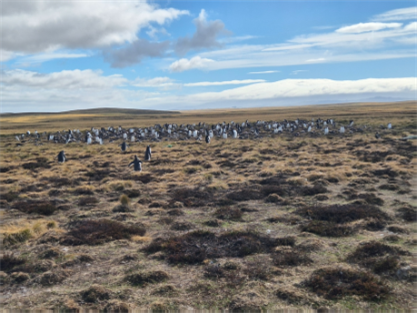
gratitude and divine timing. Watching Magellanic
penguins nesting and nurturing new life in their
natural sanctuary fills me with unadulterated joy—
a gentle reminder of the wonders of creation.
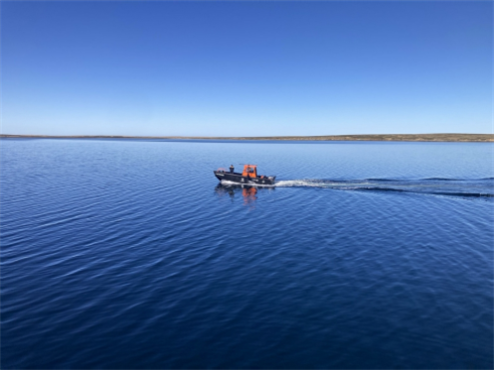
Of course, deployment brings its own trials.
Between gathering sonar seabed imagery and
ensuring safe navigation, harsh weather and daily
obstacles constantly test us. Yet, with a shared
team spirit and God’s grace guiding our path, we
are overcoming every hurdle and making great
progress.
My journey has also been enriched by a wonderful
spiritual home at St. Cuthbert’s Church. Gathering
for weekly Bible study, attending services led by
our RAF padre, and celebrating the Harvest
Festival with the Mission to Seafarers have truly
anchored my soul.
I am now halfway through this meaningful
deployment. While I am thoroughly enjoying this
change of scene and purpose, my heart looks
forward to returning home—to share these stories,
reunite with you all, and lift my voice in song once
again.
Jenny
 ADVANCE DATES FOR YOUR DIARY
Nov 8
ADVANCE DATES FOR YOUR DIARY
Nov 8 Remembrance Sunday
Nov 13 & 14 Christmas Fair
HAPPY BIRTHDAY IN OCTOBER
John Mitchelmore, Craig Miles, William Brown.
HOSPITAL SUNDAY
This Sunday, we will be holding another of our
annual services at Stoke Damerel parish church.
In recent years we have referred to this service as a
‘Celebration of Health and Healing.’ However, for
many years we spoke of ‘Hospital Sunday,’ and
some of us still do. The first service was probably
originally held during the middle years of the
nineteenth century to raise finance towards the
construction of The Royal Albert Hospital and Eye
Infirmary and Children’s Ward for Devonport,
Stonehouse, Cornwall and West Devon, known to
locals as the “The Royal Albert.” Today most
people would remember the building just as
Devonport Hospital.
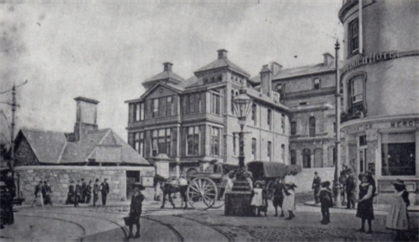 DEVONPORT HOSPITAL
The first section of the hospital opened in
December 1863, eighteen months after the
foundation stone had been laid by the Earl of
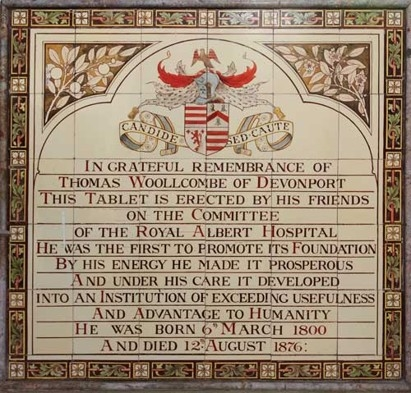
Mount Edgecumbe. There was a plaque in the
hospital dedicated to Thomas Woolcombe, who
had been very much involved in the creation of
the hospital.
The Woolcombe family was very active in
Devonport. Another member, Humphrey, is
remembered on a prayer stall, or Litany Desk,
still to be seen in Stoke church.
The hospital building served the community of
Devonport for many years. Following the creation
of the National Health Service, the hospital
transferred to the Ministry of Health in 1948 and
then, in 1963, became part of Plymouth General
Hospital, the hundredth anniversary of the opening
of Devonport Hospital.
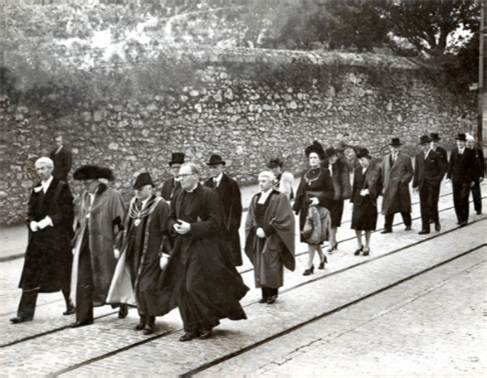 CIVIC PROCESSION 1947
For many years, this service was considered to be
a major civic event in Plymouth, with hundreds
attending. Dignitaries including The Lord Mayor,
other mayors, City Councillors, Aldermen, local
authority employees, doctors, medical staff from
the hospitals and from GP practices, local M.P.’s,
Hospital and Naval Chaplains as well as
representatives of Ambulance, Police, Fire, and
other services generally attended our services.
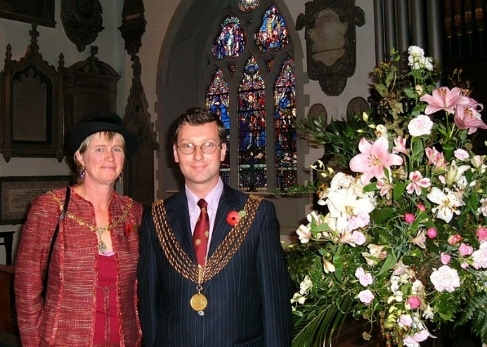
In 2005 the Lord Mayor attending the service was
Councillor Patrick Nicholson who had previously
worshipped here for many years, and whose
mother, Patricia, was also a Plymouth Councillor
for many years. Patrick is pictured below with his
wife, Sally, now also a Plymouth City Councillor.
Unfortunately, there was a period of about
ten years when the celebration was abandoned.
About seven years ago it was reintroduced in a
revised format and although the service may
never be as large as it used to be, we hope to
continue for many years. Currently we endeavour
to raise a small amount for St. Luke’s Hospice but,
as has been the case in the past, this may vary in
future years.
Tony Barnard
Hubb Support, 17/08/2020